Lind-Wasm Runtime Contexts
Lind-Wasm embeds a modified Wasmtime runtime to execute cages and grates. This page describes how Lind-Wasm tracks Wasmtime execution contexts when control moves between cages, grates, 3i, and RawPOSIX.
The core problem is that not every transfer back into Wasmtime has the same requirements. Some operations must return to the exact execution context that issued the original call. Others only need any compatible execution context for the target grate. Lind-Wasm handles these cases differently.
For general upstream Wasmtime concepts and APIs, see the Wasmtime documentation. The sections below focus only on the pieces needed to understand Lind-Wasm's runtime integration.
Wasmtime Concepts Used by Lind-Wasm
Store
In Wasmtime, a Store is the top-level container that owns runtime objects. A
single Store may own multiple Instances, and every Instance must belong to
exactly one Store. Runtime items, such as functions, tables, memories, and
globals, are allocated within the Store and are tied to its lifetime.
Module & Instance
- A
Moduleis only a compiled binary: it contains code and type information but no runtime state. - An
Instanceis the executable instantiation of aModulewithin aStore.
You cannot read memory, table, globals, or call functions on a Module. All executable interactions happen through an Instance.
VMContext
Each Instance has an internal data structure called VMContext. VMContext
is a raw pointer used by JIT-generated machine code. It contains information
about globals, memories, tables, and other runtime state associated with the
current instance.
Call Stack
Although WebAssembly defines an abstract operand stack and structured control flow, Wasmtime lowers all function calls and stack frames to the native call stack of the executing host thread. Each Wasm function is compiled into a normal machine function that receives a VMContext pointer as an implicit first argument. Local variables, temporaries, and control-flow state are therefore represented using standard native stack slots and registers.
Wasmtime attaches a VMRuntimeLimits structure to every VMContext, which stores a stack-limit pointer. At function-entry, compiled code inserts a prologue check comparing the current native stack pointer against this limit; exceeding it triggers a Wasmtime stack-overflow trap rather than a process-level segmentation fault.
Memory
Wasmtime implements each linear memory as a sandboxed region in the host virtual address space. At instantiation time, the runtime reserves a contiguous virtual range using mmap and commits only the portion required by the module’s initial size.
Each memory is represented internally by a VMMemoryDefinition structure embedded in the instance’s VMContext. The VMContext is passed as an implicit argument to all JIT-compiled functions. Every load or store instruction is lowered to native code that first reads the memory’s base pointer and current length from the VMContext, performs an explicit bounds check, and then translates the Wasm address into a native pointer (base + offset).
Lind-Wasm Runtime Lookup
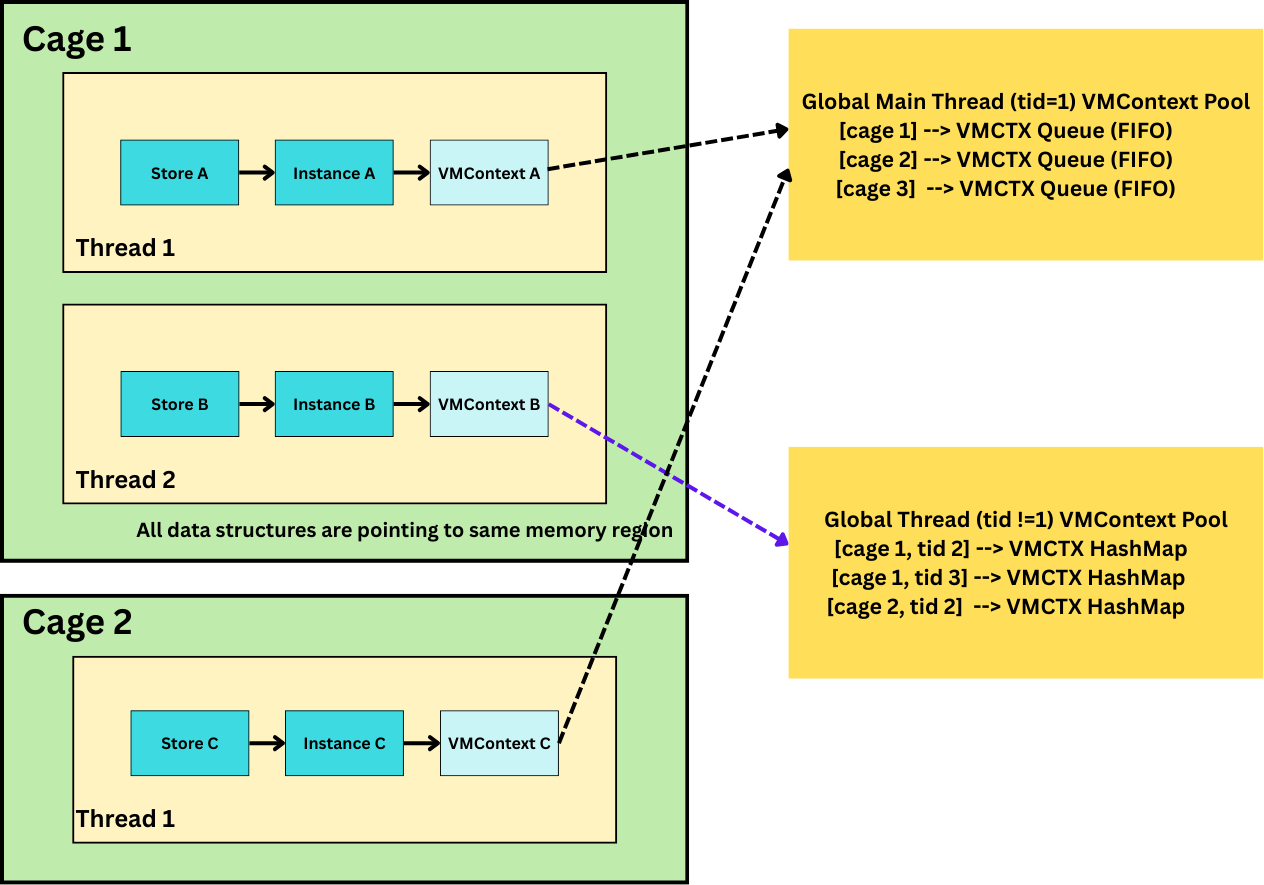
Lind-Wasm provides a runtime-state lookup and execution-transfer mechanism for 3i, enabling controlled transfers of execution across cages and grates.
Unlike a conventional WebAssembly execution model, where control flow stays
inside one Wasmtime Store, one Instance, and one linear call stack,
Lind-Wasm must sometimes re-enter a Wasmtime module from outside the currently
executing module or continuation. However, not all such re-entries are
equivalent.
Some operations must resume execution in the same continuation context that originally issued the call. Others only need a compatible execution context for the target grate. The implementation therefore distinguishes these cases explicitly rather than treating all runtime lookup as one uniform mechanism.
Execution Scenarios Requiring Runtime Lookup
1. Process-like operations (fork, exec, exit, pthread)
The first scenario occurs during process-like operations such as fork, exec, and exit. These operations create, clone, replace, or terminate Wasm process state. Their semantic handling is performed in RawPOSIX, and the code that performs that handling is not necessarily running in the same cage or grate that originally issued the syscall.
After RawPOSIX completes the semantic work, execution must return into Wasmtime so that Wasm code can continue. At that point, lind-wasm cannot rely on any implicit “current” (the caller is RawPOSIX when transferring control from RawPOSIX to Wasmtime) runtime state. Instead, it must explicitly recover the execution context associated with the original caller's (cage_id, tid).
These operations are continuation-sensitive. In particular, fork and exit rely on Asyncify’s paired unwind/rewind transitions such as start_unwind / stop_unwind and start_rewind / stop_rewind. Those transitions must occur in the same Wasmtime instance and asyncify state that originally issued the syscall. Resuming in a different instance, even if it shares the same linear memory, breaks that invariant and may lead to incorrect callback behavior or wrong return values.
Therefore, process-like operations must resume in the active execution context corresponding to the original (cage_id, tid).
2. Grate calls (cross-module execution transfers)
The second major runtime-transfer scenario arises during grate calls. A grate call transfers control from one Wasm module to another, for example from a cage into a grate or between grates.
Unlike clone, exec, and exit, grate calls are not continuation-sensitive. A grate call does not need to resume execution in the exact Wasmtime instance that originally initiated the transfer. Instead, it only needs to enter a compatible execution context for the target grate.
In the current implementation, that compatible context is represented not by a single shared runtime state, but by a worker pool managed per grate. Each worker owns:
- its own Wasmtime
Store - its own instantiated grate
Instance - all workers with the same grate ID attach to the same linear memory
- its own independent Wasm call stack region inside the shared linear memory
Operationally, a grate call is executed by leasing one available worker from the target grate’s GrateHandler, invoking the grate entry trampoline (pass_fptr_to_wt) inside that worker, and returning the worker to the pool after the call completes.
Why grate calls use workers instead of continuation lookup
A Wasmtime Store is an execution boundary: it owns the execution-local runtime state associated with one instance execution, including call stack state and other mutable runtime-local state.
By giving each grate worker its own Store and Instance, lind-wasm ensures that concurrent grate calls do not run inside the same Wasmtime runtime context. As a result:
- parallel grate calls do not contend on one shared Wasm call stack
- they do not overwrite one another’s instance-local execution state
- they do not require Asyncify continuation matching
Data structures
VmCtxWrapper
For continuation-sensitive operations, Lind-Wasm stores Wasmtime runtime context pointers in a lightweight wrapper:
pub struct VmCtxWrapper {
    pub vmctx: NonNull<c_void>,
}
VMContext is opaque and lifetime-managed internally by Wasmtime, so the implementation stores it as a raw pointer wrapper and uses it only where exact active-context recovery is required.
Per-thread active context table
The current implementation maintains a per-cage, per-thread table of active VMContexts:
static VMCTX_THREADS: OnceLock<Vec<Mutex<HashMap<u64, VmCtxWrapper>>>>;
This table stores the currently active execution context for each thread and is used exclusively for continuation-sensitive operations, especially pthread-related syscalls and thread exit. Each (cage_id, tid) maps to at most one active VMContext.
Grate worker template
Reusable grate workers are created from a shared per-grate template:
pub struct GrateTemplate<T> {
    pub engine: Engine,
    pub module: Module,
    pub linker: Linker<T>,
}
Grate request
Each grate submission is marshalled into a request object:
pub struct GrateRequest {
    pub handler_addr: u64,
    pub cageid: u64,
    pub arg1: u64,
    pub arg1cageid: u64,
    pub arg2: u64,
    pub arg2cageid: u64,
    pub arg3: u64,
    pub arg3cageid: u64,
    pub arg4: u64,
    pub arg4cageid: u64,
    pub arg5: u64,
    pub arg5cageid: u64,
    pub arg6: u64,
    pub arg6cageid: u64,
}
A GrateRequest represents one cross-module execution transfer. It includes the target handler address, the calling cage identity, and up to six (value, cageid) pairs so the callee can interpret pointer-like arguments in the correct ownership / address-space context.
Grate handler and worker pool
Each grate owns a GrateHandler<T>, which manages a reusable pool of workers and defines how incoming grate calls are scheduled. The handler supports two concurrency policies:
pub enum ConcurrencyMode {
    Parallel,
    Serialized,
}
- Parallel: multiple calls may execute concurrently as long as different workers are available
- Serialized: callers may submit concurrently, but only one call is allowed to enter the grate at a time
Workers are leased for the duration of one call and automatically returned to the pool afterward.
Worker-local stack isolation
Although different grate workers execute in different Wasmtime Stores and Instances, they may still attach to the same underlying linear memory region. For that reason, workers must not share the same stack range in linear memory.
Lind-wasm addresses this by partitioning the grate stack arena into per-worker stack slots. Each worker is assigned:
- a
stack_base - a
stack_top
Before every grate call, the worker resets its __stack_pointer to the top of its private slot. This ensures that each call begins from a clean stack state inside that worker’s dedicated stack region.
Conceptually, this gives each worker:
- independent Wasmtime execution state at the
Store/Instancelevel - independent stack space inside the shared linear memory arena
Together, those properties preserve isolation for concurrent grate execution.
Execution flow
To support intercage interposition without modifying the kernel or Wasmtime itself, lind-3i provides a user-space dispatch layer that allows system calls and other calls to be redirected across cages and grates.
At a high level, the dispatch path works as follows:
Callback definition
On the Wasmtime side, the exported entry trampoline knows how to re-enter the Wasm module and dispatch to the correct target handler.
Handler registration
When a Wasm module registers a handler, the redirection metadata is recorded so that lind-3i can later route incoming requests to the correct target grate.
Cross-cage / cross-grate invocation
When a call from cage A is routed to grate B:
- the request reaches 3i through the normal dispatch path
- 3i sends the request to the Wasmtime callback function using information registered in the handler table
- Lind-Wasm resolves the target grate handler for B
- the target
GrateHandlerleases an available worker - the request is executed inside that worker by invoking the grate entry trampoline (
pass_fptr_func) - when the call finishes, the worker is returned to the pool
Dispatch inside the grate
Inside the target worker, the Wasm entry function receives the marshalled handler address and arguments, then dispatches to the appropriate grate-side implementation.